



If you’ve ever been part of a Center of Excellence (CoE), you’ve probably experienced a moment where a senior leader asks, “So… what impact is the CoE actually having?”
You know the answer. Teams collaborate better, leaders ask better questions, delivery feels smoother, and confidence is up. But turning that into something measurable is where it gets tricky.
In this post, we’ll talk about how you can prove the impact of your center of excellence (CoE), what that looks like in practice, and how Stellafai can help you do this better.
The Real Problem is that the Impact You Show Needs More Work
Imagine a CoE supporting 20 product teams with agile coaching.
After three months, the impact could be that teams say retrospectives feel “more useful”, standups are shorter, and there are fewer escalations to leadership.
But when the CIO asks for evidence, the CoE might only be able to say: “Feedback has been positive.”
That’s not wrong, but it’s not enough. This is because there are no baselines or ways to compare teams that have received coaching vs teams that haven’t.
Coaching impact is also hard to measure, especially when the organization isn’t already strong on data.
How to Prove the Value of Your CoE to Leadership, Clients, and Prospects
Sentiment, confidence, and team comfort don’t fit neatly into traditional dashboards. So what your team needs is measurable proof of your impact so you can continue getting executive support. Here’s how to do this;
1. Establish baselines (even imperfect ones)
One of the simplest but most powerful ways is to just start somewhere. This is because even a weak baseline is better than none.
An example we’ve seen frequently is when a CoE rolls out Stellafai to support team coaching. Before the coaching starts, they run a short pulse survey across teams. It could be quick questions like:
- “How confident are you in your team’s way of working?”
- “How comfortable are you raising risks early?”
- “How clear are priorities week to week?”
Scores aren’t perfect. Some teams respond inconsistently, and that’s okay. But now, the CoE has:
- A starting confidence score per team
- A shared definition of what “better” means
- Something to measure against in 30, 60, and 90 days
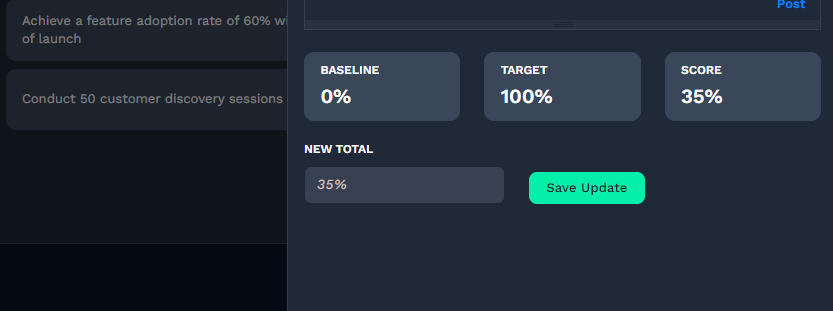
Without a dashboard to keep this baseline or score, this data either doesn’t exist. So you need to document it so you can track progress over time.
2. Lean into what’s working well
When most CoEs build tracking dashboards, they often focus on the biggest goal. However, even metrics like confidence can sometimes be a leading indicator of your impact.
For example, if team A’s delivery metrics are flat but confidence in decision-making has increased steadily over 8 weeks, that’s something to work with.
Because instead of panicking, the CoE can use this insight to explain to leadership that “While the team is still stabilizing, decision confidence has risen by xx.” If you have some historical data, you can also add that: “Historically, delivery improvements follow 1–2 quarters later.”
This is a much stronger, reassuring story than: “Delivery metrics haven’t improved yet.”
3. Target your coaching effort to where it matters
Sometimes, your CoE can get sidetracked so you spend all your resources in the wrong area, especially when demand is high and capacity is limited.
What you can do in this scenario is prioritize spread your resources between hands-on support and asynchronous support.
For example, A CoE might be required to support 30 teams but only has the capacity to deeply coach 10.
Instead of spreading your coaches thin across all 30;
- Compare sentiment and confidence trends across all teams
- Identify teams with declining clarity or rising frustration
- Prioritize real-time coaching with those teams and support the others where necessary.
This way, you can clearly say, “We focused on these 10 teams because data showed the highest risk and opportunity.”
With Stellafai, you can also support the other teams through asynchronous coaching. Record videos, share resources, respond to requests without the extra admin work.
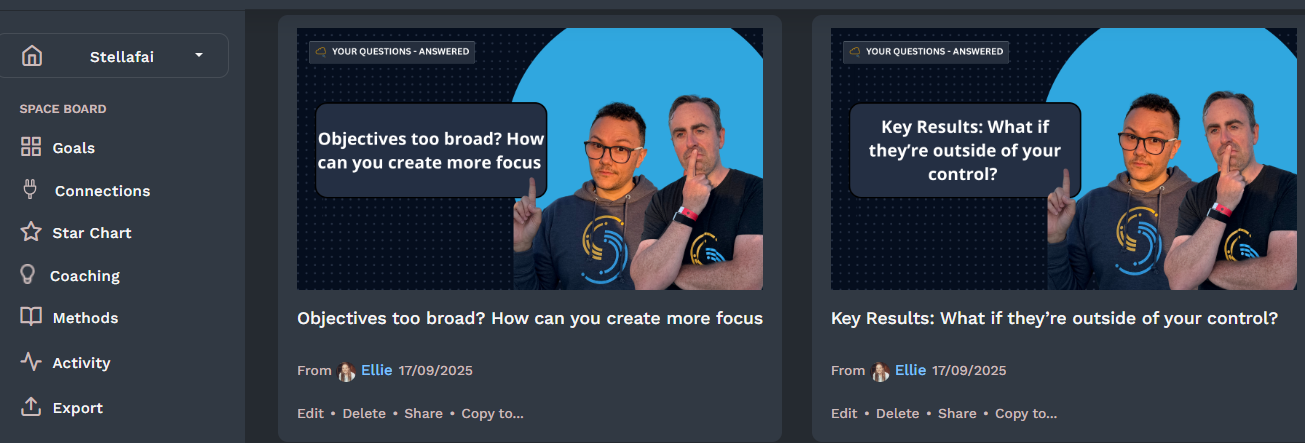
You can also track how much time, resources and support you’ve given via the platform and see your impact in real-time. Find out more about it here.
4. Rely less on end-of-engagement feedback
When working with external coaches or consultants, the temptation is to get feedback after the engagement and then use that in your conversations with leadership.
However, at that point, its often too late to influence their decisions. So instead, track:
- Team confidence and any other valuable metrics before coaching
- Any changes during the engagement
- Sustainability after the coaches roll off
A key frustration we’ve noticed with center of excellence engagements is in measuring impact over time, not just at milestones. So you need to think about getting insights frequently and being agile with your learning.
If your running an engagement for six months and you get all this information by month 3, you can start identifying which exact improvements have stuck, which teams regressed and where internal coaching needs to step in.
It’s Time to Start Tracking Your Impact
At the end of the day, Centers of Excellence struggle because their impact is hard to see.
The work is happening. Teams are changing. Confidence is growing. But without baselines, regular signals, and a way to track progress over time, that value stays invisible to the people who need to see it most.
Proving the impact of your CoE doesn’t require perfect data or complex reporting. It starts with being intentional about what you measure, capturing change early, and learning continuously as the organization evolves.
If you want to see how Stellafai helps CoEs make this impact measurable through baselines, insights, and ongoing visibility, book a free discovery call here and we’d be happy to show you.
.png)
.png)
.png)